Woven Threads
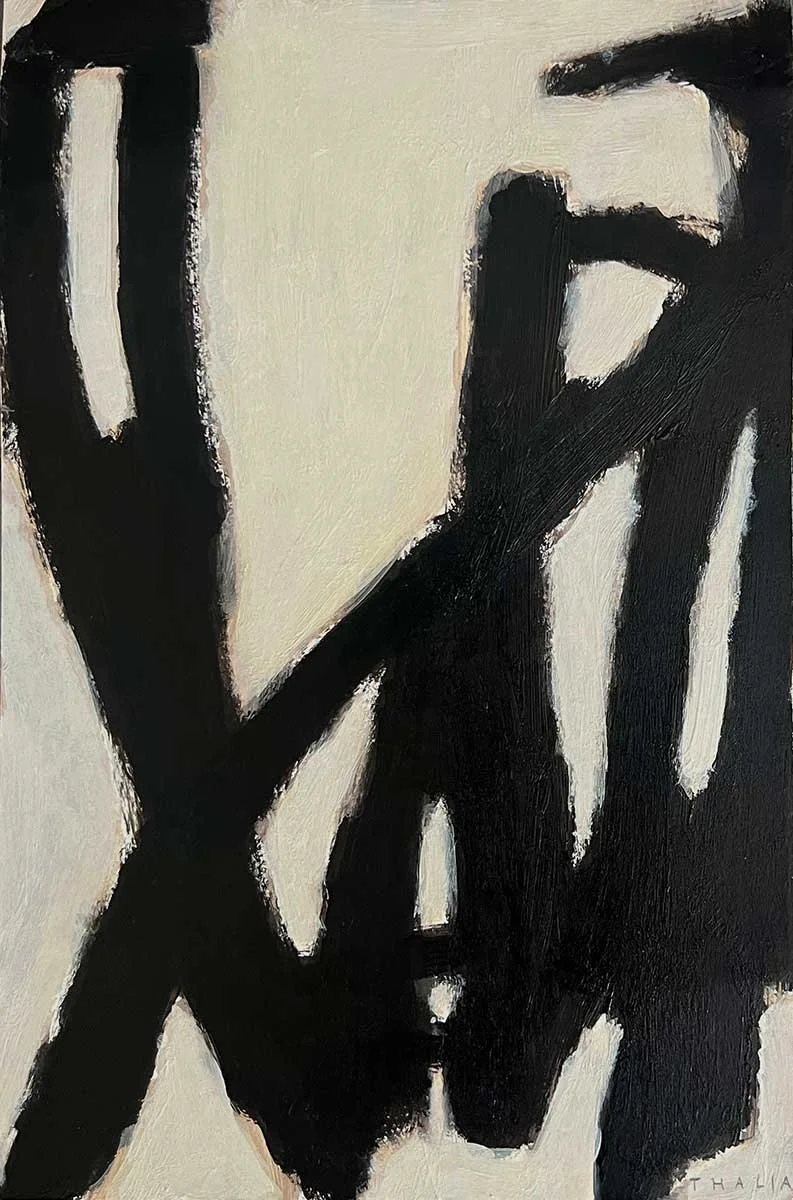
Margot Virelli, Woven Threads, 2025, 6×9 inches, acrylic on paper
If you were to look at any woven object up close, the pattern and threads would appear quite different from when observed from a distance. The working of the thread would be impossible to see the further back the viewer stepped.
A similar experience occurs when observing the archaeological record more intimately versus through a broader, more generalized lens. Ancient people and their practices take on new meaning and interpretation when considered through different lenses of perspective.
The natural world, as observed through a microscope versus a telescope, has a similar outcome; what one observes up close is very different from what one observes at a distance.
As I’ve pondered on perspectives, my art practice has manifested illustrations and my inner anthropologist has unearthed new and surprising questions.
Questions from a telescopic view
Are all observations and encounters of a spiritual or religious nature the same?
How do worshipers of different religious persuasions experience communion with the divine?
Does it feel the same or different to worship Kali versus Jesus? If so, would a Hindu describe the same emotional experience in worship as a Christian?
Does communion with a particular divine being provide a distinct experience or energetic presence that is common or familiar to worshippers of the same faith?
Questions from a microscopic view
What are the energetic and emotional differences between divine presence, ideologies, and personal experience?
How do I experience divine presence? What are the distinctions between my own thoughts and feelings and an outside source?
Is what I feel during my spiritual practice markedly similar to what others feel, or is my experience, like so many, a novel one?
In a similar vein, although it is difficult (maybe even impossible) to relate to or comprehend the spiritual and emotional experiences that ancient worshipers of divine presence may have had during their religious practice, through their writings, symbology, and the expressions of their modern descendants, can I glean some aspect of what worship and the feeling of spirituality was like for them, and through that understanding, relate to my own spiritual practice a little bit better?
Weaving the two together
Can humans relate to one another through a common or familiar worship experience?
If the answer is yes—all experiences of worship feel similar—would there be any way of confirming that connection and relativity? And, is common experience important?
If the answer is no—each act of communion with divine presence is singular and unique—is it possible for worshipers to describe the emotional, chemical, spiritual, or mental experience of interacting with the divine in a way that outsiders can understand and relate to?
In attempting to answer these questions, I’m not choosing to lean into material concepts of impossibilities or improbabilities of the existence of divine presence, or of using empiricism in this exploration.
Instead, I’m simply curious what it feels like when others recognize an encounter with what they would describe as the divine. Is it a familiar and universally consistent experience, or is every encounter unique and undefinable, or is it somewhere in the middle?
For me, this is simply an “in search of” episode of the tapestry of human emotion, creativity, and the woven emphasis of spiritual and religious expression over the course of ancient and modern traceable history; a comparing, of sorts, of my spiritual practice to the proverbial and not so proverbial other, to better understand this phenomenon of human experience that I take part in.
Through my own microscopic lens of spirituality
Personally, I’ve found there are some aspects of my interactions with divine presence easy to explain, while other, more intimate and emotional moments of communion are impossible to articulate with any clarity, so I’ve chosen not to share them.
What is clear, and what I can describe from a lifelong spiritual and creative practice, has been a growing recognition and awareness over time that I am encountering, communicating, and even building a relationship with a particular, distinct, and consistent presence that I can reach out to and communicate with; a presence who is much smarter than I am, who has a definite personality and identity that is different from my own, and with whom I can enjoy this communion on a regular basis whenever I intentionally reach out.
For some reason I have yet to fully comprehend why this being wants to talk to me. It feels like a mutually happy communion, and I appreciate that.
When I meditate, pray, and reach out directly to this particular presence, my interaction is, from my own perspective, real and unambiguous in the same way that recognizing my husband’s voice, his walk, and his unique energy is familiar and easy for me to distinguish in a crowd.
Each of my relationships has a distinct feel because the individuals I’m sharing that connection with are unique. I recognize my husband, Erik, my children, friends, and other family members as separate individuals. The more intimate we become, the more I get to know their distinct personality and energetic vibe. The more I interact with them, the easier it is to recognize them quickly and with confidence.
I see them and I hear them empirically when we talk, but I also feel and sense them too.
The feeling or vibe I feel from my husband helps to build trust in our interactions because it is recognizable, and that feeling has grown over our 30+ years together from a slight sense to a real understanding of who he is.
From another perspective, one that is a further step back from my own, is how my children experience my husband.
Although they haven’t enjoyed the same kind of intimate relationship with him that I have, they have had a deep and meaningful relationship of their own with him, and we all agree on general observations of his personality, temperament, and energy. He puts off a very trustworthy, gentle, yet grounded and resolute vibe. We all feel it. We have all interacted with it in our own ways.
We have come to know him both physically and emotionally. The experience of being with my husband is relatable among those who know him, although I imagine we’ll never know the exact and unique ways we’ve developed that understanding or how it feels internally.
As a family, we’ve discussed how he makes us feel. We’ve used the English language and found we all gravitate to similar words when describing our experience of him.
In many ways, I can relate this familial interaction to those I consistently have with a singular, distinctive, divine presence. I recognize the energy and personality of this being I communicate with regularly, despite not being able to tell you a single thing about how they wear their hair or whether or not they have tattoos. It’s never come up.
From the telescopic lens of others
An outsider, especially one who prefers material over spiritual relationships, may find my experience quaint, absurd, or empirically improbable. That makes sense. It’s difficult to describe the experience of any relationship to one who hasn’t encountered it for themselves.
What feels familiar to me may not feel familiar or relatable to another, and there are many materialist methods for explaining away what one has not encountered for themselves with academically and scientifically accepted explanations, like psychological phenomena.
Weaving the two together
As one who appreciates curiosity and exploration, I enjoy hearing different perspectives from my own. Throughout my life, I have wondered how much of my spiritual practice is rooted in superstition, psychological phenomena, or delusion.
In fact, because I want to be as honest with myself as possible, I have abandoned a number of behaviors and attitudes that were based in superstition and delusion. It’s important to me to know the difference between what is fake or of my own imagination and what is real in terms of responding to energetic resonance, presence, or communing with an outside source, even if that source doesn’t wear a white robe, a cape, or a long white beard.
As I play with, work to understand, and hold myself to higher standards of scrupulous analysis, not letting myself off with an “I believe, therefore I am right” approach to my faith, an interesting thing has happened. The more I analyze and put myself in the “prove it” box, the more real and honest my spiritual practice has become.
Not only has this constant attempt at moving in and moving out to see different ways of looking at the same thing, but how I see others and my relationships with both friend and foe has taken on a new and more harmonious framework.
Viewing the world and the universe, as well as myself as an entity within it, through multiple lenses and perspectives has helped me relate with more generosity and honesty, with more compassion and empathy, and to view those who are very different from myself as an important, integral, and intricate part of the woven tapestry of human experience.
Conclusion
As I continue to paint these detailed threads of a broader and distinct woven element, both through my art practice and spiritual musings, my lens will shift and change. I’ll imaginatively observe up close each strand and move farther back with my arms crossed and my finger tapping my lip as I think about what it all means.
Humans are a curious bunch. The whys and wherefores that compel us to explore ourselves, others, nature, and the greater universe rarely make perfect sense, at least to those of us trying to use a variety of scopes and lenses to view it all from.
Whether or not I am able to answer the many questions I have posed is not as important to me as taking time to consider them. Not every question needs an answer. But that doesn’t mean we shouldn’t ask.
Please feel free to share your thoughts and comments below.